
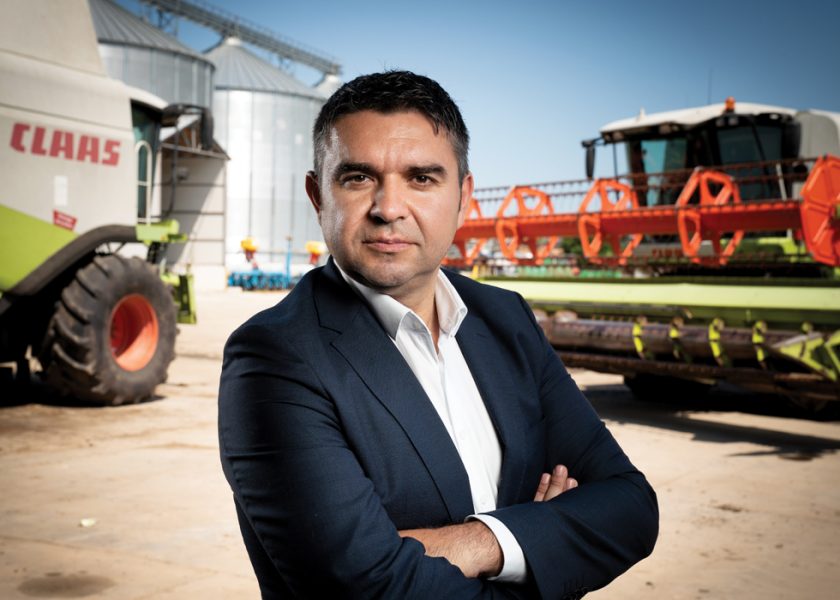
When it comes to agriculture, many point to the 90% of farmers in Romania who work the land only for subsistence. However, there is also another category, which has chosen business models from outside the borders.
With what results?
At the end of spring and beginning of autumn, the plains of southern Romania are full of wheat and barley that have gone fallow and of corn that has come tens of centimeters out of the ground. “We had a rainy spring, after the autumn and winter were a bit dry”, says Mihai Rezeanu (40 years old), co-owner of the Refdan farm in Islaz, Teleorman county. Miki, as the local people call him, runs the business with his brother, Dan Rezeanu (42 years old). Both studied management at the Academy of Economic Studies in Bucharest and both decided to get involved in agriculture.
The American experience. Their story begins in 2004, when they took over the business that their parents had started six years before.
Settled in the southern part of the country, in Islaz, a town almost 60 kilometers from Alexandria and 10 kilometers from Turnu Măgurele, the parents offered mechanized services to farmers in the area and worked 40 hectares that they had inherited .
In 2004, the brothers Mihai and Dan Rezeanu decided to take over the reins of the business. To begin with, they asked themselves a simple question: “What are we doing?”. And they decided to visit America. “For about two years, I went from farm to farm in the United States. I saw how what the Americans do turns out well”, explains Mihai Rezeanu, confessing that, where they could, they copied the American model in agriculture in detail. Mainly, they wanted to know how Americans treat the big crops, how they work the land, and how a grain farm is organized.
“We made a strategy and asked ourselves what we needed the first time”, continues the entrepreneur. And they decided to buy high-performance machines, so in 2005, they accessed funds of 150,000 euros from the pre-accession programs. Looking back, Rezeanu now says that this moment was a real challenge. Consulting companies were few at the time and with great difficulty they found a specialist who understood their business needs. They worked on that project for a year, given that, at the moment, such a study to obtain financing with European money does not last more than two to three months. For that time, the 150,000 euros represented a rather large amount, being the equivalent of at least four three-room apartments in a respectable area of Bucharest.
A second project close in value followed, and the money was directed to the renovation of the farm, a step followed by the accumulation of as large areas of land as possible. They bought more properties, but also began to lease land massively. At the moment, the Refdan farm works around 2,400 hectares, of which it owns 480 hectares, the rest being leased. Which also means some additional problems, because the current administrative provisions do not help tenants. A fact also noted by one of the biggest foreign farmers in the Bărăganu area, Arnaud Perrein (51 years old). “When you lease a piece of land, you don’t just work, you also invest in it to increase its value,” explained the French farmer in a discussion with NewMoney.
Basically, the lessees complain that many of the lands do not have a clear legal situation, but also that there is a risk that the lessees are not serious and do not respect the contract to the end. In addition, many of those who rent their land have very small holdings. “We ended up having about 2,000 tenants”, Rezeanu takes stock, confessing that this burdens their administrative operations a lot.
Plowing on the computer. Approximately 700 of the 2,400 hectares in the Refdan portfolio are irrigated with the help of a station in the construction of which the Rezeanu brothers invested approximately 1.4 million euros, money secured from bank loans. And the investment is more than efficient, the water being captured directly from the Danube, which is located near the farm’s land.
Since large-scale agriculture is no longer done with a rented tractor and two refurbished combines, the two entrepreneurs ended up with a fleet of machinery in which they have invested over time approximately four million euros, with two million euros only last year last. And this is not all. The entire surface they work on is digitized. More precisely, all the lands are monitored from the satellite, with the help of a dedicated software.
Because the machines are also state-of-the-art, the work schedule is also drawn from the computer. Practically, the mechanist only has to supervise the machines, which work autonomously according to the commands sent by software to the on-board computers of the tractors, combines or seeders. Mihai Rezeanu says that technology evolves extremely quickly. He found that there are big differences in equipment between a combine purchased in 2014 and another bought two years ago. It shows that each tractor or combine has its own system
Thomas Smith
November 19, 2019Ut sit amet accumsan tellus. Morbi commodo maximus efficitur. Vivamus eu nunc scelerisque massa neque, ac mollis libero pretium sit amet.
Monica Brandson
November 19, 2019Ut sit amet accumsan tellus. Morbi commodo maximus efficitur. Vivamus eu nunc scelerisque massa neque, ac mollis libero pretium sit amet.
Admin
March 1, 2020Ut sit amet accumsan tellus. Morbi commodo maximus efficitur. Vivamus eu nunc scelerisque massa neque, ac mollis libero pretium sit amet.
Admin
March 1, 2020Ut sit amet accumsan tellus. Morbi commodo maximus efficitur. Vivamus eu nunc scelerisque massa neque, ac mollis libero pretium sit amet.